Rotary Club of Canberra Burley Griffin News Notes 9th November 2026
This week a number of members will be driving to Hay NSW to participate in the Presentation Day at Hay War Memorial High School where we will promote our scholarship scheme for indigenous students. Therefore there will be NO meeting this week, however please come to our Annual general Meeting the following Thursday 19th November at the Royal Golf Club and contribute to the AGM and Annual Elections.
Last meeting: The Adventures and Demise of L31 Zeppelin and its crew
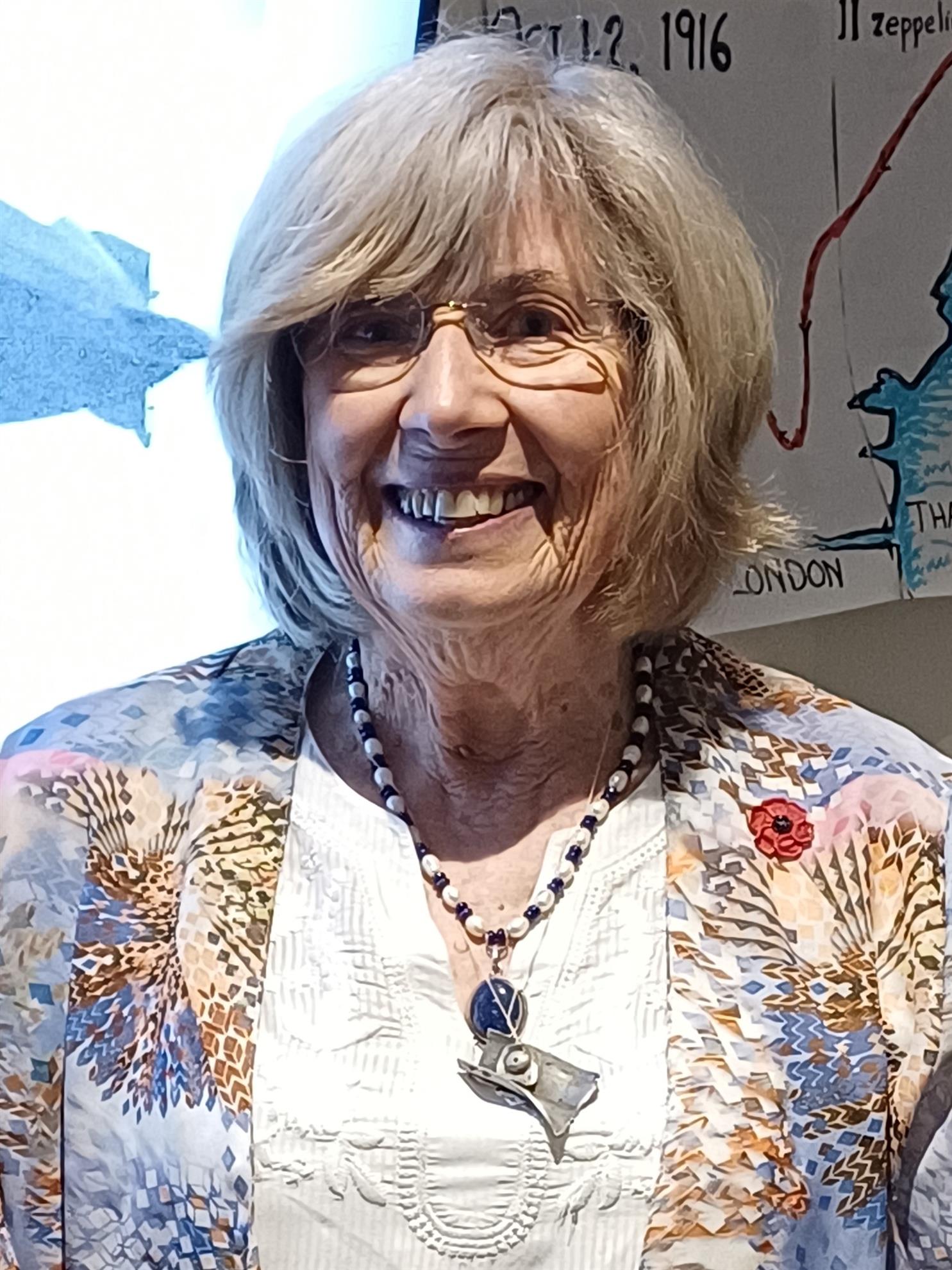
On Thursday, 5 November, Margaret Wright entertained and informed us about the roles of zeppelin bombers in the first half of World War I and the fate of one, designated L31.
At the time, powered airships with rigid frames were the only viable form of air transport. German engineer Count Von Zeppelin’s airships carried around 25 passengers, had comfortable lounges, a kitchen, a steward, toilets, sleeping quarters, and even enclosed smoking rooms. In contrast, aeroplanes were flimsy and could carry only 2 or 3 passengers.
At the outbreak of WW1, Germany had 5 airships, with 88 eventually built. Each was armed with 5 machine guns and 2 tonnes of bombs. At first, zeppelins were used for escort, scouting and observation duties. But soon the German High Command began to consider using the airship to drop bombs. The zeppelin was the original 'stealth bomber', cruising under cover of darkness so high (about 2 miles) that it could barely be heard.
The Kaiser feared that neutral countries might see zeppelin bombing raids as a new atrocity if civilians were killed and gave strict instructions to bomb military targets only. However, accurate bombing was near impossible from an airship, particularly at night and from a great altitude. Cities, visible at night and hard to miss, became the target.
Air defences in Britain were minimal at the start of the war. Aircraft were hopelessly outclassed by the airships, struggling to reach the same height, and pilots would become dizzy from the thinned oxygen. Altogether, 1915-16, there were 51 zeppelin raids (each of up to 11 airships) which caused 557 deaths, 1358 injuries, and extensive damage.
By mid-2016, Britain’s air defences had improved, including the following changes
universal night-time black-out (but the Thames still glistened, and was a guide)
anti-aircraft batteries installed on the ground around main targets
defensive aircraft no longer sat on their runways, faced with an hour-long climb to reach the zeppelin's height. They flew in relays, and there was probably at least one already at the same height as the zeppelin, ready to attack on sight
there was now a ring of searchlights around London, ready to be switched on and begin searching the sky whenever a zeppelin was suspected, and
detecting the faint buzz of zeppelin engines was improved by “listening mirrors” that amplified the sound and the recruitment of blind people with more acute hearing.
Heinrich Mathy, aged 32, had made numerous raids on Britain. His most deadly raid was on London on 8 September 1915, with 22 people killed and 1.5 million pounds worth of property damage. This was in his 'Lucky L13' zeppelin.
On the night of 1 October 1916, Mathy was heading for London again, this time in the three-month-old L31. It carryied 4 tons of bombs and 19 crew. It was very cold at altitude, so the crew wore layers of bulky clothing and fur boots. There was no room for parachutes.
Eleven airships left their bases for the raid that night, but unfavourable weather conditions delayed all but Mathy who, with his skill and luck, had overcome these difficulties and set a solitary course for London. At about 8.00 p.m., L31 was caught in the beams of searchlights. Mathy decided to abandon his raid on London. He dropped his bombs to lighten the ship, then made off towards the west, still pinpointed by the beams of several searchlights.
Second Lieutenant Wulston Tempest, aged 23, was rostered onto the patrol that evening. His instructions were to go no higher than 8,000 feet, but he thought it ridiculous, and decided to fly higher. Just before midnight, he was about two hours into his patrol. A large portion of this time had been spent in climbing to bring his BE2c plane to its patrolling height of about 14,500 feet - over two and a half miles high. It was straining to reach the height, and he was feeling the lack of oxygen.
From this height he saw several of the searchlights to the north of London - about fifteen miles away - converge upon one distant, silvery, cigar-shaped object. Tempest knew exactly what he was looking at and headed towards the zeppelin at top speed. As he got closer to it, he found himself flying though large amounts of anti-aircraft fire as more and more ground batteries began firing at the airship.
Tempest dived at the zeppelin, firing a burst from his machine-gun as he approached, and another burst into the underside of the L31 as he passed below. His gun was loaded with a mixture of tracer, incendiary and ordinary ammunition, so he could see that he was hitting his target, but nothing happened. Tempest got unto position under the tail of the ship and flew along its length, firing a long burst as he went. That did it! He suddenly saw the envelope begin to glow from the inside like "a giant Chinese lantern" and then flames began to spurt out of the forward end and the zeppelin began to fall. Tempest manoeuvred out of its way and flew back to his base where he made a slight crash landing, injuring himself with what later turned out to be a fractured skull.
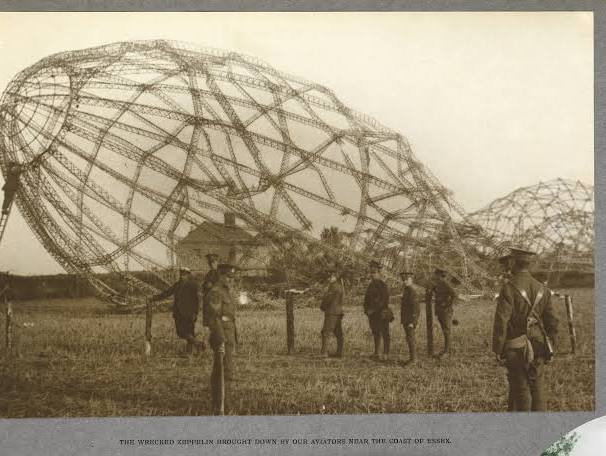
It was time for Mathy and his crew to decide: burn or jump (without parachutes). Mathy chose to jump. He wrapped a thick scarf (a present from his wife) around his head and leaped from the gondola, falling to earth a little way from the ship, which crashed at Oakmere Farm, Potters Bar, North London. All 19 crew members died.
After the loss of Mathy and the L31, it became clear that the days of the airship as an offensive weapon were numbered, and zeppelin bombing raids on London ended.
When Margaret’s grandfather left England in 1922 to settle in Australia with his wife and family, he brought a long piece of metal. It was part of the L31. The story is that his two brothers lived nearby, rode their motorcycle to the wreck and chopped a piece off with a hacksaw. They gave it to Margaret’s grandfather, a ship building engineer, who subsequently divided it into 12 pieces for various family members. Here, in distant Australia, Margaret still has one small piece of that once-famous terror of the skies.
Margaret was recently featured in a City News spread, available at:
Stephen McMillan (with thanks to Margaret for sharing the text of her presentation)
Our guest speaker: Margaret Wright
Terrifying sight of bomber Zeppelin over English town in WW1
Zeppelin finally downed by RAF pilot flying a tiny Tiger Moth type of plane shooting incendiary bullets into the hydrogen filled Zeppelin.
Save these dates in your diary
13 November
Visit Hay to present scholarships to Indigenous students
Hay War Memorial High School
19th November
Annual AGM and Elections for 2026/7
26th or thereabouts
Christmas Party
10 December
UN Human Rights Day with Zonta Canberra remembering victims of domestic violence.
Peace Bell
Next meeting
Our next meeting will be lunch at the Royal Canberra Golf Club on Thursday 5th November at 12.30pm.
Please respond to Eric’s invitation if you can come.
Duty Roster
Programme and Roster
12thNovember
Hay, NSW
No Meeting
19thNovember
Pres Neil
Elections and AGM
Pres. Neil and whole club
26th or thereabouts
Santa or substitute
Christmas Party
If you cannot perform your allocated duty, please arrange a replacement and advise the Acting President for that meeting (listed above). Please advise the Bulletin Editor of any planned absences to avoid being rostered on while away.
This Bulletin is the creation of Bill and Stephen who work late into Sunday night, so please send any contributions by beer o'clock or at least before the first werewolves fully morph, on Sunday to andrews79@iinet.net.au
Rotary Saying of the Week
There are risks and costs to a programme of action,
but they are far less than the long-range risks
and costs of comfortable inaction.
John F Kennedy 1963
(so true - remember when we look at membership plans.....Ed.)